Net fishing on the Indian River changed by law in 1909. That year the Florida legislature passed an act against haul seines and drag nets in the coastal waters of four east coast counties, St. Lucie among them, and the man who carried it was St. Lucie County’s own representative, W. R. Hardee. The two Fort Pierce weeklies printed the call for the law, the bill, the act itself, and two years later Hardee’s own account of why he had carried it. This page reads that record for what it says about the fish and the water.
Who asked for a law on net fishing on the Indian River
In March 1909 the St. Lucie County Tribune reprinted a letter from Henry L. Hagy of Titusville, first printed in the East Coast Advocate, who signed himself one of the common fishermen. The fish dealers on the southern part of the Indian River, he wrote, had given notice that they would ask the next legislature to stop seining and the hauling of nets in the tide waters of the east coast.
Hagy wanted something stronger. He thought the dealers’ law would not protect the fish, and proposed one covering every water of the east coast, with a fine of $500 and six months at hard labor on the county roads for anyone caught hauling a seine or drag net, half the fine to go to the informant. He also wanted a four-inch mesh made the standard size for gill nets.
The bill and the act
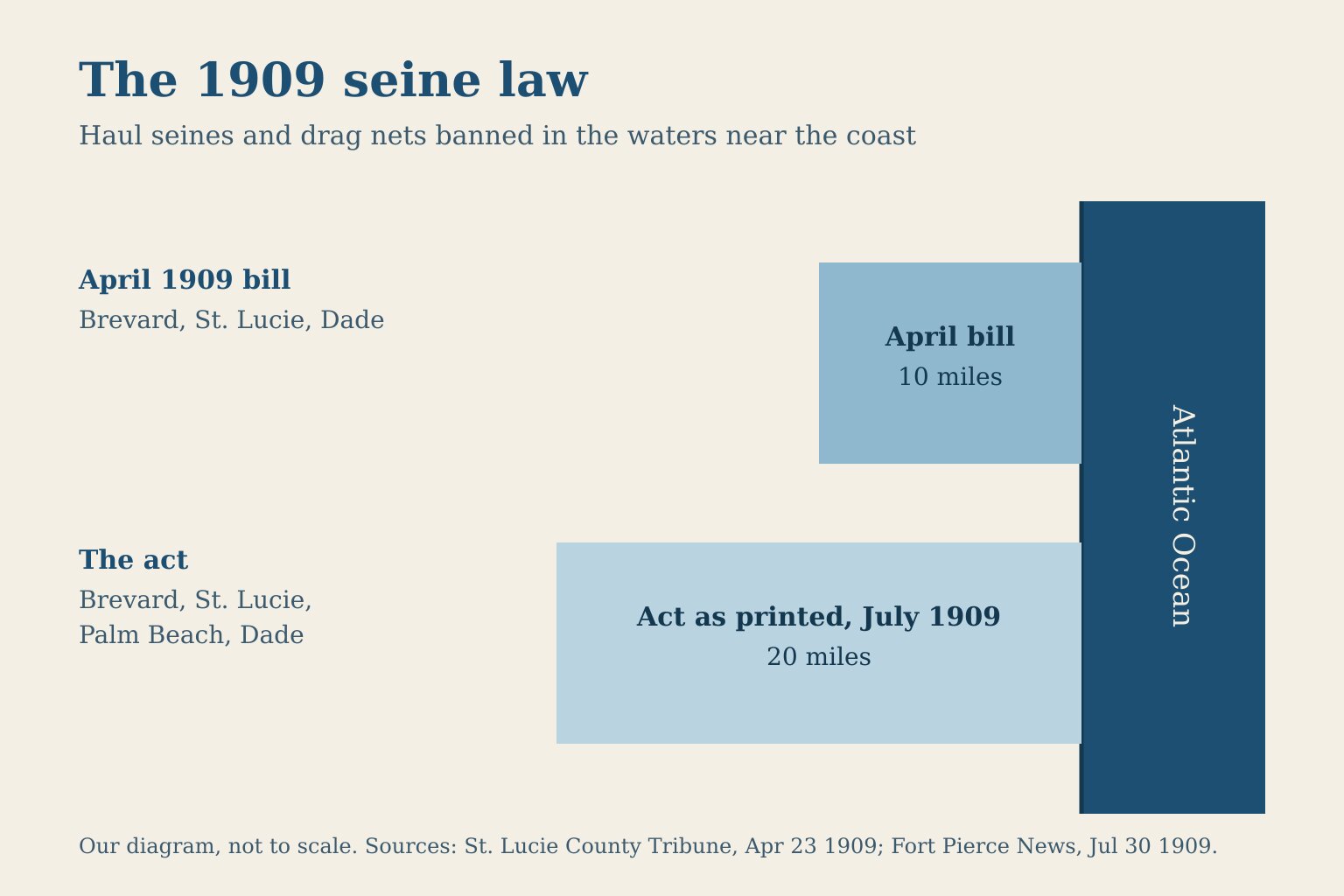
On April 23, 1909 the Tribune reported that Representative W. R. Hardee of St. Lucie County had succeeded in having his bill passed unanimously. Its title, which the paper printed, was an act to prohibit catching fish with haul seines or drag nets in the salt and fresh waters of Brevard, St. Lucie and Dade counties lying within ten miles of the Atlantic coast and north of Biscayne Bay, with the seizure and destruction of nets used in violation. The same item noted a second Hardee bill, on oyster beds and the right to plant them, sent to the Fisheries committee.
The act as the Fort Pierce News printed it at the end of July 1909 was wider. It named Palm Beach County alongside Brevard, St. Lucie and Dade, and it reached twenty miles west of the Atlantic coast, not ten. Hardee’s own description in 1911 gives the same four counties and the same twenty miles, so the change was made before the act passed.
What the seines were doing to the river
The fullest account in the papers is Hardee’s, in a letter from Jensen that the Tribune printed on its front page on September 29, 1911, under the headline that the Hardee law was defended. Before his election, he wrote, he had asked the county’s fish dealers through the press to draw up a law that suited them, and the bill that reached him in Tallahassee had been advertised in the county papers by a well-known Fort Pierce fish firm. Before he went to Tallahassee he was shown, on the fish dock at Jensen, the kind of fish the seines were catching. Some were weighed in front of him: it took eleven of the seine-caught fish to make a pound.
That, he wrote, was the condition all along the Indian River. By his own knowledge tons of those small fish were caught, and fish thrown overboard in violation of the law lay foul and decaying on the riverbanks, until people living along the river front shut their doors and windows against the stench and feared it would bring sickness.
The dealers had their own reason. Hardee wrote that the seines were catching so many fish that dealers refused to take them, the waters were being stripped and the fish thrown away, and that one dealer had lost heavily by buying more than the markets could take. The fishermen insisted that all of their seine catch be accepted. The dealers, with few exceptions, told him to stop the seines by law if he could, and he passed the bill they sent him.
Two years on
Hardee opened his letter by noting that every year about that time there was great commotion on the Indian River over enforcing the fish laws. Once the law took effect, he wrote, no special effort was made to enforce it. He charged that some dealers had ignored it, paid their fines and gone on seining, calling the fine a license, and that the law had been wanted only to frighten the small dealer who could not afford a lawyer.
That is one man’s account, written in defense of his own law, and nothing we found in the papers counts the fish in the river before or after. What they do show is the scale of the trade the fight was over: a county sketch the Tribune printed in May 1909 named Fort Pierce and Sebastian as the principal shipping places for fish, with dozens of firms kept busy shipping.
The river after 1911
The two Fort Pierce papers end in December 1911, so this record ends there. For the same river in the same years, see Indian River oysters, 1905 to 1911, early drainage canals at Fort Pierce and mosquito season on the Indian River. For the lagoon’s fish today, read biodiversity in the estuary and the water quality crisis.
Frequently asked questions
What was the 1909 seine law?
An act of the 1909 Florida legislature that made it unlawful to catch fish with haul seines or drag nets in the salt and fresh waters of Brevard, St. Lucie, Palm Beach and Dade counties lying within twenty miles of the Atlantic coast and north of Biscayne Bay. It provided for the seizure and destruction of nets used in violation. St. Lucie County’s representative, W. R. Hardee, carried it.
Why was seining banned on the Indian River?
By the account of its sponsor, written in 1911, the seines were taking great numbers of small fish, more than the dealers could sell. He described fish so small that eleven weighed a pound on the dock at Jensen, and riverbanks strewn with decaying fish thrown overboard. The fish dealers, he wrote, asked for the law.
Was the seine law enforced?
Not well, according to the Fort Pierce papers. In 1911 its sponsor wrote that no special effort had been made to enforce it and that some dealers paid their fines and kept seining, treating the fine as a license. The papers end in December 1911, so this record stops there.
Sources
This page is drawn from the two Fort Pierce weeklies of the time, via Library of Congress, Chronicling America. From the St. Lucie County Tribune: March 5, 1909 (page 1, Hagy’s letter, reprinted from the East Coast Advocate), April 23, 1909 (page 4, the bill), May 28, 1909 (page 1, the county sketch) and September 29, 1911 (page 1, Hardee’s letter). From the Fort Pierce News: July 30, 1909 (page 16, the act as passed). The legal descriptions are paraphrased from the printed titles; the scans are the authority.