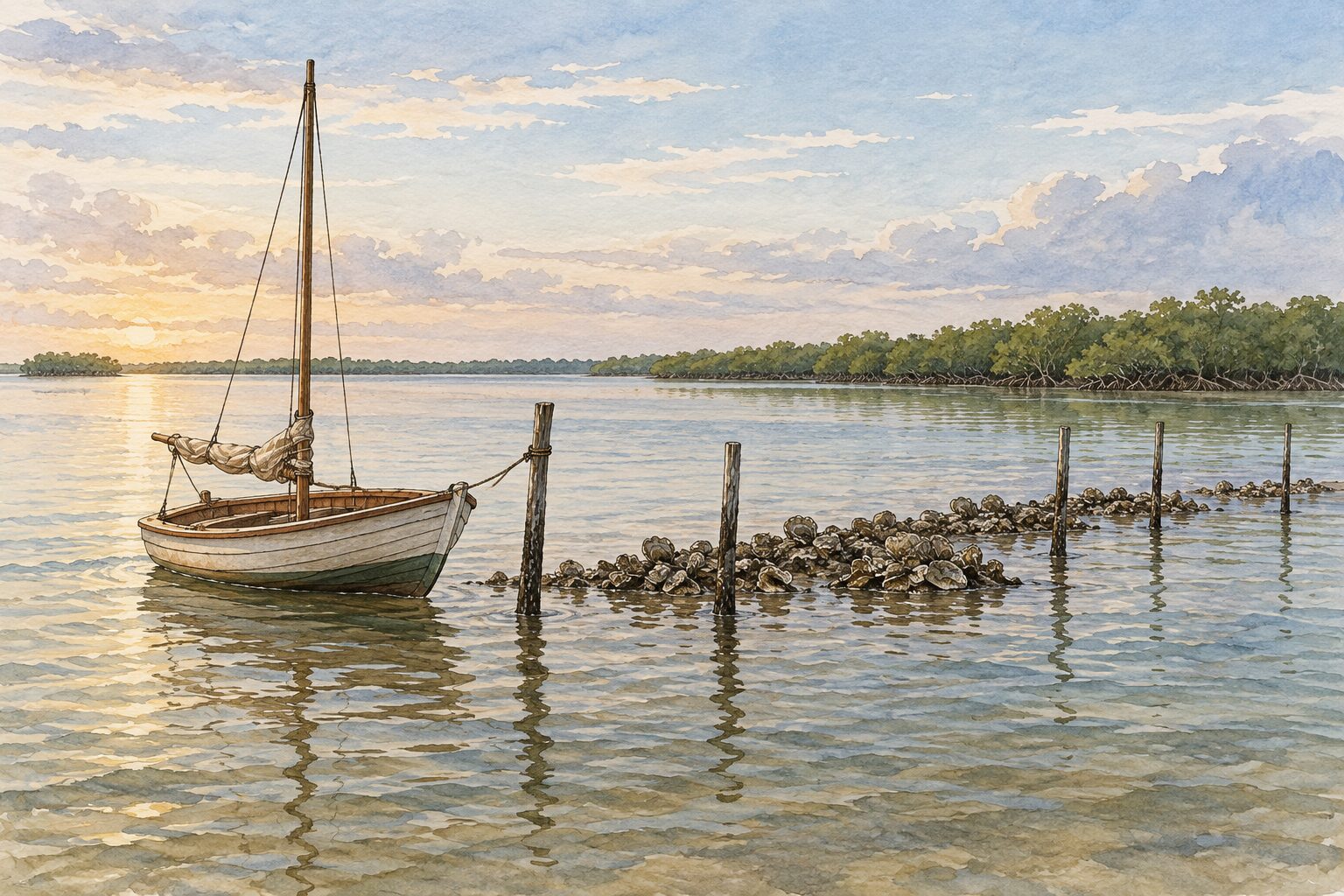
For a few months each winter, the Indian River had an oyster trade. Boats were made ready in the fall, an oyster house opened its doors for the season, sellers in Fort Pierce took orders for fresh Indian River oysters, and the county granted stretches of river bottom to people who meant to plant oysters there. This is the lagoon's oyster trade as the county knew it between 1905 and 1911.
The winter business
By early October 1905, F. A. Hine of Hine and Company, oyster dealers, was back in Fort Pierce from a summer at Cape Charles, Virginia, and at work getting his boats ready for the winter business. By the middle of the month the firm's oyster house had opened again for the season, and oysters could be had there at any hour of the day.
Hine's summers belonged to the Chesapeake. In July 1907 he wrote from Cape Charles, where he was working oysters and clams, that he expected to spend the winter in Fort Pierce again and would probably go into the oyster business there as usual.
A pineapple grower's other crop
C. M. Nelson, an old-time Fort Pierce resident who no longer lived in town, was back visiting friends at the start of November 1905. For many years he had combined pineapple growing with the oyster business, and done well at both. The busy season in each fell in opposite months of the year, so one never got in the way of the other.
That fall he was looking over the oyster beds north of Fort Pierce, where he thought he might open an oyster house to supply his trade to the south.
Fresh Indian River oysters
Two Fort Pierce sellers named where their oysters came from. In January 1911 the City Restaurant advertised fresh oysters received every day from Wabasso, up the river, and called them the best oysters in town. Another advertisement that winter invited readers to drop a card at the post office saying how many fresh Indian River oysters they wanted. The oysters would be opened after the order came in, then delivered.
The next winter the Superior Market had fresh Wabasso oysters for Christmas dinners and asked customers to order early, and from Monday, December 4, 1911, the firm of Hine and Edwards had fresh oysters for sale on the city dock.
Staking out a bed
Indian River oysters could also be planted. In March 1909 the county commissioners granted a firm named Fairbanks the exclusive right to plant oysters on the submerged land off a 660-foot stretch of Indian River shore, with the bounds to be marked by stakes or buoys.
In October 1911 they granted the same right to W. C. Sneden of Jensen, who had told them he was determined to plant oysters in the river off the north shore of a lot in the same surveyed township (township 37 south, range 41 east). His grant spelled out the rule: the edges of the beds had to be marked by stakes or buoys no more than 50 yards apart, as the law required.
Old beds in the channel
Old oyster beds were part of the river's geography too. In the summer of 1909, launch parties rode the Indian River to the St. Lucie Inlet on Sunday afternoons for a dip in the surf, and the route was a roundabout one. Shallow water, bars and old oyster beds stretched the trip to about four miles, to reach an inlet a little over two miles away as the crow flies.
Supper, while the oysters lasted
When the town raised money, it often served oysters. On Thanksgiving Day 1909 the Ladies Aid Society of the First Presbyterian Church held a bazaar and oyster supper in the Improvement Club hall. Supper was announced at five o'clock, the dining room stayed crowded until after seven, and then the doors were closed because the oysters had run out.
In February 1911 the Improvement Club gave an oyster supper and dance in its hall for the benefit of the Fort Pierce band, and the town turned out for it. Mrs. McCarty and a dozen helpers served oysters fried or stewed, with salads, pickles, coffee, ice cream and cake.
The lagoon's oysters now
Oysters still grow in the Indian River Lagoon, and rebuilding their reefs is part of the work to bring the lagoon back. Our guide to the lagoon's biodiversity covers the eastern oyster's place in the estuary, and lagoon restoration covers the reefs and living shorelines being built today. For the same river in the same years, see Pelican Island, 1906 to 1911, and for the fishing trade on the same water, our sister site The Fort Pierce Annals.
Frequently asked questions
Were there oyster beds in the Indian River in the early 1900s?
Yes. In 1905 an old-time Fort Pierce resident in the oyster business was looking over the beds north of town for a place to open an oyster house, and in 1911 sellers in Fort Pierce offered fresh oysters from Wabasso, up the river.
Could anyone plant oysters in the Indian River?
Not just anywhere. In 1909 and 1911 the St. Lucie County commissioners granted exclusive rights to plant oysters on particular stretches of submerged land in the river, with the bounds marked by stakes or buoys.
When was oyster season on the Indian River?
Winter. F. A. Hine readied his boats in the fall for the winter business, Hine and Company's oyster house opened in October, and the town's oyster suppers and Christmas orders came in the cool months.
Sources
This page is drawn from the two Fort Pierce weeklies of the time, via Library of Congress, Chronicling America: the St. Lucie County Tribune of October 6, 1905 (page 1), October 13, 1905 (page 1), November 3, 1905 (page 8), July 19, 1907 (page 5), March 5, 1909 (page 1), December 3, 1909 (page 1), February 24, 1911 (page 1), October 13, 1911 (page 6) and December 22, 1911 (page 9), and the Fort Pierce News of July 23, 1909 (page 1), January 13, 1911 (page 5) and December 8, 1911 (page 7). The illustration was made for this page.