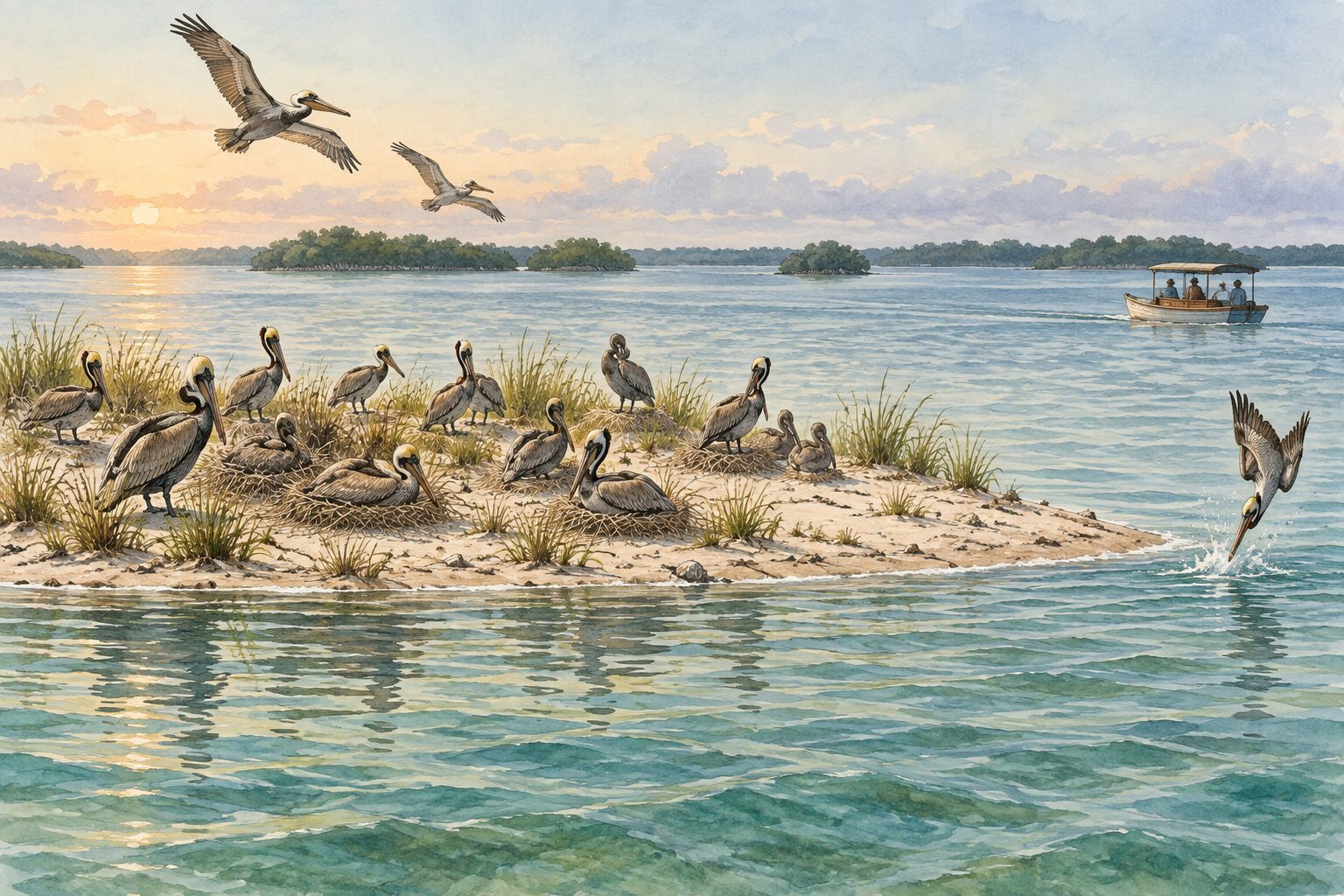
Up the Indian River from Fort Pierce, southeast of Sebastian, lies a small island that pelicans had used for as long as anyone could remember. By 1909 it was a federal bird reservation with a warden of its own. Pelican Island was bare ground and coarse grass, it held several thousand nesting brown pelicans early each season, and on weekends it drew launch parties from up and down the river who came to watch the birds and take their pictures. This is the island as the county knew it between 1906 and 1911.
An acre of coarse grass
The island was small. The News put it at about an acre. The birds had killed off everything that grew on it except a rough, coarse grass, and they built their nests out of that grass. Early in the nesting season the island held several thousand pelicans, and every spring many thousands of young birds swam away from it on their first voyage.
They had been there a long time. By the accounts of 1909, the pelicans were already on the island when the first white explorers came through, and no one living could remember a time before them.
The bird that dives for its supper
The brown pelican is a big waterbird with a pouch hanging from the lower edge of its enormous bill, large enough to hold many quarts, which it uses to catch its food. It hunts from the air. It circles over the water until it spots a fish below the surface, then drops on it in a fast, clumsy-looking dive, and comes up floating with its catch.
How close the colony came
A few years before 1909 the colony nearly disappeared. Once tourists began coming down the Indian River, the killing started, and between hunters and visitors the birds and their nesting ground came close to being wiped out. Without protection, both accounts of 1909 agree, the pelicans would have been exterminated.
The Audubon Society persuaded the national government to protect the birds and their island, and Paul Kroegel of Sebastian was put in charge as special commissioner for the government and the National Audubon Society, to guard the birds from reckless hunters. His story, and how the island became the country's first federal bird reservation in 1903, is told by our sister site, The St. Lucie Record.
Under protection the colony grew quickly. In May 1909 the News reprinted an estimate from a New Smyrna paper that at least fifteen thousand birds of different kinds were nesting on the island that season, and that since the reservation was set up the birds had grown more numerous and much tamer.
Kroegel told one party of visitors that spring that the island was one of only three places in the United States where pelicans hatched, the others being a small island near Tampa and one on the Texas coast, and that this one was the largest of the three.
Going up the river to see them
In the same years the colony recovered, a trip to Pelican Island became a favorite outing on the river. In January 1906 a fishing party spent a Saturday there taking pictures. On the last Sunday of March 1909, a Fort Pierce party went out with Capt. Frank Depew, described as one of the most efficient guides on the coast, and Kroegel came along to explain the island and its birds. Harry E. Hill of the Florida Photographic Concern, the Fort Pierce photography business, brought a camera and came home with views of the island and its hundreds of pelicans.
When the News wrote that trip up, it stirred up interest, and the following week Kroegel told the paper that several parties were planning trips of their own. On a rough, stormy Saturday in April, a party of young people went out by launch anyway and spent several hours watching the birds on their own ground.
The trips kept coming. On a Sunday in September 1909, a Wabasso outing took the river course around the island. At the end of January 1910, a correspondent up the river called it one of the few pelican rookeries in the United States and wrote that it had been the center of attraction that Sunday for a great number of local people and visitors, carried out in a roomy launch that was a little crowded. Wabasso parties went again in December 1910 and January 1911, the second time coming home with snapshots, and that April a couple from Atlanta were visitors there.
Pelican Island now
Pelican Island is still protected today. The pelicans fish the same waters covered in our Indian River Lagoon guide, and the lagoon's other animals are in our wildlife guides.
Frequently asked questions
Where is Pelican Island?
In the Indian River Lagoon, southeast of Sebastian, up the river from Fort Pierce.
What birds nest on Pelican Island?
Brown pelicans above all. In 1909 one estimate put at least fifteen thousand birds of different kinds nesting there in a single season.
Who protected Pelican Island?
Paul Kroegel of Sebastian, special commissioner for the federal government and the National Audubon Society. The St. Lucie Record tells his story.
Sources
This page is drawn from the two Fort Pierce weeklies of the time, via Library of Congress, Chronicling America: the Fort Pierce News of April 2, 1909 (page 1), April 9, 1909 (page 4) and May 21, 1909 (page 4, reprinting the New Smyrna Breeze), and the St. Lucie County Tribune of January 12, 1906 (page 1), July 9, 1909 (page 1), February 4, 1910 (page 6) and January 27, 1911 (page 6). The illustration was made for this page.