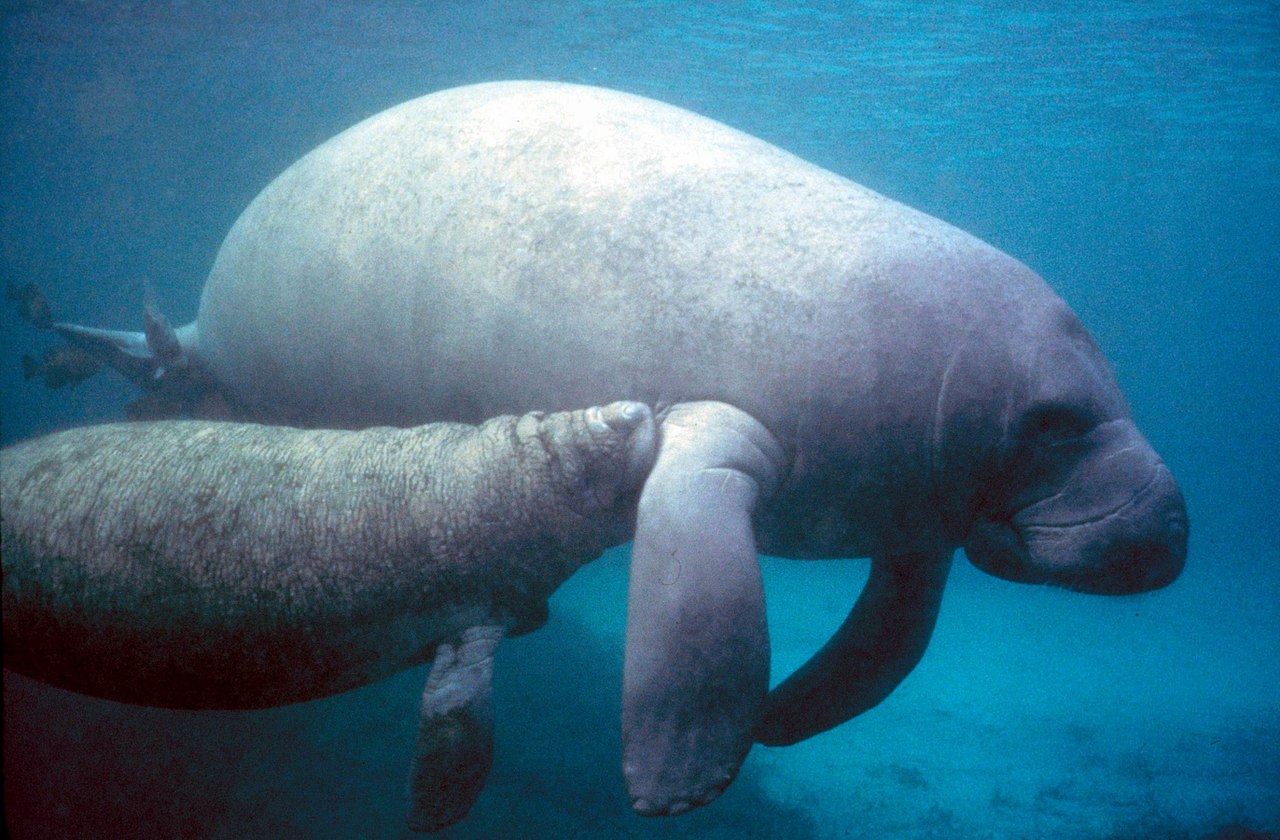
Few animals are as closely associated with the waterways of Florida's Treasure Coast as the Florida manatee. These slow-moving, herbivorous marine mammals have inhabited the Indian River Lagoon for thousands of years, grazing on seagrass beds that line the shallow estuary. Today, Florida manatees in the Indian River Lagoon face an uncertain future shaped by habitat degradation, boat traffic, and a catastrophic loss of the seagrass they depend on for food.
What Is a Florida Manatee?
The Florida manatee (Trichechus manatus latirostris) is a subspecies of the West Indian manatee, which belongs to the order Sirenia. Sirenians are the only fully aquatic herbivorous mammals, a group that also includes the dugong of the Indo-Pacific and the now-extinct Steller's sea cow. Despite their bulk and aquatic lifestyle, manatees are more closely related to elephants than to whales or seals — a connection evident in their thick, wrinkled skin and toenail-like structures on their flippers.
Adult Florida manatees typically measure 9 to 10 feet in length and weigh between 800 and 1,200 pounds, though individuals exceeding 13 feet and 3,500 pounds have been documented. Their bodies are rounded and torpedo-shaped, tapering to a broad, paddle-like tail that propels them through the water at a typical cruising speed of 3 to 5 miles per hour. Their forelimbs have evolved into flexible flippers used for steering, crawling along the bottom, and bringing food to the mouth.
Florida manatees are obligate breathers — they must surface to breathe, typically every three to five minutes when active, though they can remain submerged for up to 20 minutes while resting. Their lungs extend along the length of the body and function as a buoyancy control system, allowing manatees to hover at any depth without effort.
The Indian River Lagoon: Critical Manatee Habitat
The Indian River Lagoon stretches 156 miles along Florida's east coast, from Volusia County south through Brevard, Indian River, St. Lucie, and Martin counties. This shallow, brackish estuary — often no more than three to five feet deep — provides ideal conditions for the seagrass meadows that Florida manatees depend on. The lagoon has long been recognized as one of the most important manatee habitats in the southeastern United States.
Florida manatees in the Indian River Lagoon use the estuary for feeding, resting, mating, and as a travel corridor between the Atlantic Ocean and freshwater tributaries. The lagoon's warm, shallow waters are particularly important during transitional seasons when manatees move between winter warm-water refuges and summer foraging areas. Aerial surveys conducted by the Florida Fish and Wildlife Conservation Commission (FWC) have documented hundreds of manatees using the lagoon system during both winter and summer counts.
The connection between Florida manatees and the Indian River Lagoon is not incidental — it is existential. The lagoon's seagrass beds are the primary food source for manatees in the region, and the estuary's sheltered waters provide protection from ocean swells and strong currents that manatees generally avoid.
Diet and Feeding Behavior
Florida manatees are herbivores that spend six to eight hours per day feeding. They consume between 4 and 9 percent of their body weight in vegetation daily — for a 1,000-pound manatee, that means 40 to 90 pounds of plants every day. In the Indian River Lagoon, their diet consists primarily of seagrasses, including shoal grass (Halodule wrightii), manatee grass (Syringodium filiforme), and turtle grass (Thalassia testudinum).
Manatees use their flexible, prehensile upper lip — which is split into two independently moving halves — to grasp and tear vegetation. Their teeth are uniquely adapted to their abrasive diet: manatees have only molars, which are continuously replaced from the back of the jaw in a conveyor-belt pattern known as marching molars. As front teeth wear down from grinding sandy vegetation, they fall out and are replaced by new teeth moving forward from the rear. This adaptation allows manatees to process tough, silica-rich seagrasses throughout their lives.
When seagrass is unavailable, Florida manatees will feed on other aquatic vegetation, including algae, water hyacinth, and hydrilla. However, these alternatives are nutritionally inferior to seagrass, and manatees that are forced to rely on them for extended periods may suffer from malnutrition and reduced body condition.
Warm-Water Refuges and Seasonal Migration
Florida manatees are cold-intolerant. When water temperatures drop below approximately 68 degrees Fahrenheit, manatees face the risk of cold stress syndrome, a potentially fatal condition that suppresses immune function and can lead to skin lesions, pneumonia, and death. This vulnerability drives a seasonal migration pattern that shapes manatee distribution across the state.
During the cooler months, typically from November through March, Florida manatees congregate at warm-water refuges — locations where water temperatures remain above the critical threshold. These refuges fall into two categories: natural warm-water springs and industrial warm-water outfalls. On the Treasure Coast, manatees in the Indian River Lagoon rely on the warm-water discharge from the Florida Power & Light plant at Riviera Beach as well as natural inflows from tributaries and springs to the north.
As water temperatures rise in spring, manatees disperse from these refuges and travel widely along the coast and through the lagoon system, foraging on seagrass beds and freshwater vegetation. Some Florida manatees travel hundreds of miles during summer months, with individuals documented as far north as Virginia and as far west as Texas, though such long-distance movements are relatively uncommon.
Population Numbers and Trends
Estimating the total population of Florida manatees is challenging because the animals are difficult to count reliably in turbid water. The FWC conducts synoptic aerial surveys during winter months when manatees are concentrated at warm-water sites, making them easier to spot. The most recent statewide synoptic survey recorded more than 7,500 individuals, though biologists caution that these counts represent minimum population estimates, not total population figures.
The Florida manatee population grew steadily from the 1990s through the mid-2010s, a trend that contributed to the U.S. Fish and Wildlife Service's decision in 2017 to reclassify the species from "endangered" to "threatened" under the Endangered Species Act. That reclassification was controversial at the time, and it has become more so in light of the unprecedented mortality events that followed.
Threats to Florida Manatees in the Indian River Lagoon
Boat Strikes
Watercraft collisions have historically been the leading documented cause of Florida manatee mortality. Manatees are slow-moving and often feed or rest just below the surface in shallow waterways that are heavily used by recreational and commercial boats. The propeller scars that mark many living manatees — visible as parallel white lines on their gray backs — are so common that researchers use scar patterns to identify individual animals.
The FWC designates manatee protection zones in areas of high manatee activity, including portions of the Indian River Lagoon. These zones impose seasonal or year-round speed restrictions on boats to reduce the risk of collisions. Compliance with these speed zones, and enforcement of the rules, remain ongoing challenges.
Seagrass Loss and the 2021 Unusual Mortality Event
Beginning in late 2020, Florida manatees in the Indian River Lagoon began dying at an alarming rate. By the end of 2021, more than 1,100 manatees had died statewide — the highest annual mortality on record and roughly twice the five-year average. The primary cause was starvation, driven by the catastrophic loss of seagrass in the northern reaches of the Indian River Lagoon.
The seagrass die-off was itself caused by years of poor water quality. Nutrient pollution from agricultural runoff, septic systems, stormwater, and wastewater discharges had fueled persistent algal blooms that blocked sunlight from reaching the lagoon floor. Without light, the seagrass could not photosynthesize and died. By some estimates, the Indian River Lagoon lost more than 50 percent of its seagrass coverage between 2011 and 2021.
The 2021 Unusual Mortality Event (UME), as it was designated by NOAA and the USFWS, laid bare the direct connection between water quality, seagrass health, and manatee survival. Florida manatees in the Indian River Lagoon that had relied on these seagrass beds for generations were left with insufficient food. Emaciated manatees were documented throughout the lagoon system, and rescue teams from organizations like the Save the Manatee Club worked to rehabilitate starving animals.
In an unprecedented step, wildlife agencies established a temporary feeding station in Brevard County during the winter of 2021-2022, providing romaine lettuce to manatees at a warm-water refuge. While the supplemental feeding likely saved lives, biologists emphasized that it was an emergency measure, not a long-term solution.
Habitat Loss and Coastal Development
The Treasure Coast is one of the fastest-growing regions in Florida. Residential and commercial development along the lagoon's shoreline removes mangrove buffers, increases impervious surface area, and adds to the nutrient loading that drives water quality problems. Dock construction, seawall installation, and dredging activities can directly destroy or degrade manatee habitat.
Other Threats
Additional threats to Florida manatees in the Indian River Lagoon include entanglement in fishing line and crab trap lines, exposure to red tide toxins (brevetoxins), and crushing or drowning in water control structures such as canal locks and flood gates. Climate change introduces further uncertainty, potentially altering the distribution of warm-water refuges and the composition of seagrass communities that manatees depend on.
Conservation Status and the Relisting Debate
The Florida manatee was listed as endangered under the Endangered Species Act in 1967, one of the original species included on the federal endangered species list. For five decades, that designation drove protective measures including boat speed zones, habitat acquisition, and restrictions on waterfront development.
In 2017, the U.S. Fish and Wildlife Service downlisted the Florida manatee from "endangered" to "threatened," citing population growth and improved habitat protections. Conservation groups challenged the decision, arguing that the population gains were fragile and that emerging threats — particularly water quality degradation — had not been adequately addressed.
The 2021 UME intensified calls to relist the Florida manatee as endangered. The Center for Biological Diversity, Defenders of Wildlife, and the Save the Manatee Club have all advocated for relisting, arguing that the starvation crisis demonstrated that the species' recovery was far less secure than the 2017 reclassification implied. As of early 2026, the USFWS has not reversed the 2017 decision, though the agency continues to monitor the situation and review petitions.
FWC Manatee Protection Zones
The Florida Fish and Wildlife Conservation Commission establishes and enforces manatee protection zones throughout the state's waterways. In the Indian River Lagoon, these zones include slow-speed and idle-speed areas in channels, basins, and near-shore waters where manatees are frequently present.
Manatee protection zones are marked with regulatory signs along waterways and are enforceable by FWC law enforcement officers. Violations can result in fines and citations. The zones are seasonally adjusted in some areas, with stricter speed restrictions during winter months when manatees concentrate at warm-water sites.
In addition to speed zones, the Marine Mammal Protection Act and the Endangered Species Act make it illegal to harass, pursue, hunt, or harm manatees. This includes activities such as chasing manatees, separating a cow from her calf, or providing food or water to wild manatees outside of authorized emergency operations.
How to Observe Florida Manatees Responsibly
The Treasure Coast offers numerous opportunities to see Florida manatees in the Indian River Lagoon, particularly during the cooler months when they gather at warm-water sites. Responsible observation means keeping your distance, minimizing disturbance, and following a few straightforward guidelines:
- Stay back. Observe manatees from a distance of at least 50 feet. Use binoculars or a telephoto lens rather than approaching closely.
- Do not feed or water manatees. It is illegal to feed wild manatees, and providing freshwater from a hose (a practice sometimes seen at docks) habituates them to human activity in ways that increase their risk of boat strikes.
- Paddle quietly. If kayaking or paddleboarding in manatee habitat, maintain a slow pace and avoid areas where manatees are resting or nursing.
- Do not touch. Even gentle contact can constitute harassment under federal law. If a manatee approaches you in the water, remain still and let it move away on its own.
- Report injuries. If you see a manatee that appears injured, sick, orphaned, or dead, contact the FWC Wildlife Alert Hotline at 1-888-404-FWCC (3922).
The Future of Florida Manatees in the Indian River Lagoon
The fate of Florida manatees in the Indian River Lagoon is tied directly to the health of the estuary itself. Restoring seagrass coverage — which requires significant, sustained reductions in nutrient pollution — is the single most important step for manatee recovery. State and local agencies, including the St. Johns River Water Management District and the Indian River Lagoon National Estuary Program, have invested in wastewater infrastructure upgrades, septic-to-sewer conversions, and stormwater treatment projects aimed at reducing nutrient inputs to the lagoon.
These efforts are necessary but slow. Seagrass recovery, even under improved water quality conditions, takes years. In the meantime, Florida manatees in the Indian River Lagoon remain vulnerable to the compounding effects of poor water quality, inadequate food supply, boat traffic, and a changing climate. Their survival depends on whether the human communities that share the lagoon can commit to the long-term work of restoring the estuary that sustains them.
Learn more about the ecological systems that support manatees in our guides to the Indian River Lagoon, seagrass meadows and mangrove habitats, and conservation efforts on the Treasure Coast.
Frequently Asked Questions
How many Florida manatees are left?
The most recent statewide synoptic aerial surveys have documented more than 7,500 Florida manatees, though scientists note these surveys represent minimum counts rather than total population estimates. The population experienced significant losses during the 2021 Unusual Mortality Event, when more than 1,100 manatees died statewide, primarily from starvation linked to seagrass loss in the Indian River Lagoon.
Why are Florida manatees starving in the Indian River Lagoon?
Decades of nutrient pollution from agricultural runoff, septic systems, and stormwater have fueled algal blooms in the Indian River Lagoon. These blooms block sunlight from reaching the lagoon floor, killing the seagrass that manatees depend on for food. The lagoon has lost more than half of its seagrass coverage since 2011, leaving Florida manatees in the Indian River Lagoon without adequate forage.
Are Florida manatees endangered or threatened?
The Florida manatee is currently listed as "threatened" under the Endangered Species Act. It was downlisted from "endangered" in 2017 by the U.S. Fish and Wildlife Service. Multiple conservation organizations have petitioned for relisting in the wake of the 2021 mortality crisis.
Where can I see manatees on the Treasure Coast?
Florida manatees can be observed throughout the Indian River Lagoon, particularly in shallow, warm-water areas during the cooler months (November through March). Popular observation points include waterfront parks, fishing piers, and bridges along the lagoon in St. Lucie and Martin counties. Always observe from a respectful distance and never approach, feed, or touch wild manatees.
What should I do if I see an injured manatee?
Report injured, sick, orphaned, or dead manatees to the FWC Wildlife Alert Hotline at 1-888-404-FWCC (3922). You can also report sightings through the FWC's online reporting tool. Do not attempt to assist or move the animal yourself.