Along the sheltered shorelines of the Indian River Lagoon, where tidal water meets land, Florida mangrove forests form one of the most ecologically productive habitats on Earth. These salt-tolerant trees and shrubs create living architecture that stabilizes coastlines, nurtures marine life, filters pollutants, and stores vast quantities of carbon. On the Treasure Coast, mangrove forests are not merely a scenic backdrop; they are the biological foundation upon which much of the regional ecosystem depends.
Three Species, Three Strategies
Florida is home to three native mangrove species, each adapted to occupy a distinct zone along the tidal gradient. Together, they form a layered forest system that maximizes habitat complexity and ecological function across Florida mangrove forests.
Red Mangrove (Rhizophora mangle)
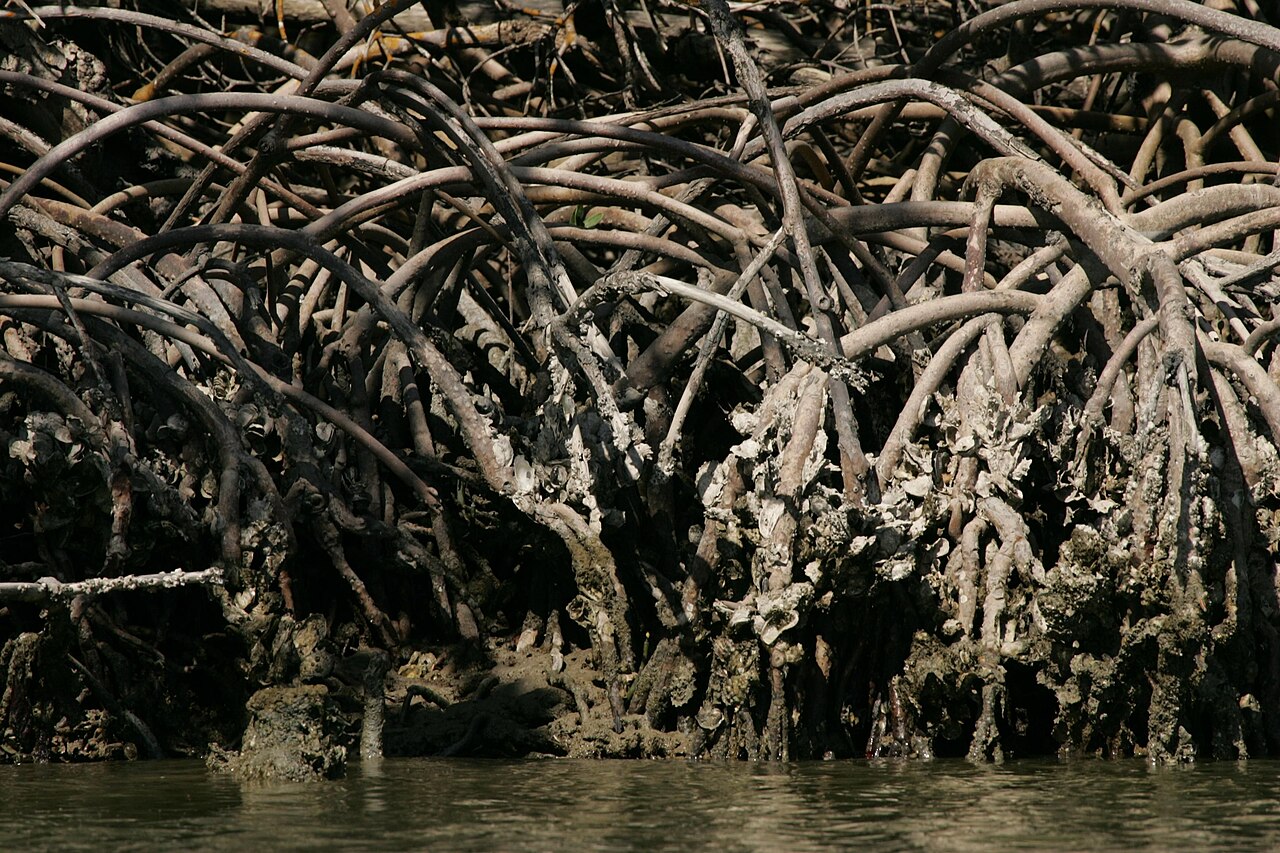
The red mangrove occupies the outermost zone, growing directly in saltwater along the water's edge. Its most recognizable feature is its arching prop roots, which descend from branches and the trunk into the water and sediment below. These prop roots serve multiple purposes: they anchor the tree against waves and currents, trap sediment to build new land, and create a dense underwater lattice that shelters juvenile fish, crabs, shrimp, and other invertebrates.
Red mangroves reproduce through a process called vivipary, in which seeds germinate while still attached to the parent tree. The resulting propagules, elongated seedlings that resemble green pencils, drop into the water and can float for weeks or months before lodging in suitable substrate and taking root. This reproductive strategy allows Florida mangrove forests to colonize new areas and recover after storm damage.
Black Mangrove (Avicennia germinans)
Found slightly landward of the red mangrove zone, the black mangrove is distinguished by its pneumatophores, finger-like projections that rise from the root system above the mud surface. These pneumatophores function as snorkels, allowing the root system to access oxygen in the waterlogged, anaerobic soil. Black mangroves also excrete excess salt through specialized glands on the undersides of their leaves; on a warm day, you can sometimes see and taste the salt crystals that accumulate on their foliage.
Black mangroves are the most cold-tolerant of the three Florida species. This adaptation has become increasingly significant as warming winter temperatures have allowed black mangroves to expand their range northward along the Atlantic coast. On the Treasure Coast, black mangroves are well established and form dense stands along many lagoon shorelines.
White Mangrove (Laguncularia racemosa)
The white mangrove occupies the highest and driest zone, growing at the landward fringe of the mangrove forest where tidal flooding is less frequent. White mangroves lack the dramatic prop roots and pneumatophores of their relatives. Instead, they are recognized by their rounded, light-green leaves, which feature two small salt-excreting glands at the base of each leaf stalk. White mangroves contribute to the overall canopy of the forest and help transition the mangrove habitat into the upland plant communities behind it.
Ecological Roles of Florida Mangrove Forests
The ecological value of Florida mangrove forests extends far beyond what is visible above the waterline. These systems provide services that benefit wildlife, water quality, coastal resilience, and global climate regulation.
Shoreline Stabilization
Mangrove root systems act as natural breakwaters. The dense network of prop roots, pneumatophores, and underground root mass dissipates wave energy, reduces erosion, and traps sediment carried by tidal currents. Over time, this sediment accretion actually builds new land, extending the shoreline seaward. Studies conducted by the National Hurricane Center and other agencies have documented that mangrove-lined coastlines experience significantly less storm surge damage than coastlines where mangroves have been removed.
Nursery Habitat
The submerged root systems of Florida mangrove forests serve as nurseries for an extraordinary diversity of marine organisms. Juvenile snook, tarpon, red drum, gray snapper, sheepshead, stone crabs, blue crabs, pink shrimp, and spiny lobster all use mangrove roots as shelter during vulnerable early life stages. The calm, food-rich environment beneath the canopy allows these species to grow before moving to open water. Research published by NOAA estimates that a large proportion of commercially and recreationally important fish species in the southeastern United States depend on mangrove habitat during some stage of their life cycle.
Water Filtration
Mangrove forests function as natural water treatment systems. As tidal water flows through the root network, sediments settle out and organic matter is processed by the microbial communities that colonize root surfaces. Mangroves also take up excess nutrients, including nitrogen and phosphorus, from the water column, helping to mitigate the effects of nutrient pollution from agricultural and urban runoff. This filtration role is especially important along the Indian River Lagoon, where nutrient loading has been a persistent water quality concern.
Carbon Sequestration
Blue Carbon: Mangroves as Climate Champions
"Blue carbon" refers to carbon captured and stored by coastal and marine ecosystems, including mangrove forests, seagrass meadows, and salt marshes. Mangroves are among the most carbon-dense ecosystems on the planet. According to research supported by NOAA and the Smithsonian Environmental Research Center, mangrove forests can store three to five times more carbon per unit area than upland tropical forests. Much of this carbon is locked in the deep, waterlogged soils beneath the trees, where low-oxygen conditions slow decomposition and allow organic material to accumulate over centuries. When mangrove forests are destroyed, this stored carbon is released into the atmosphere, contributing to greenhouse gas emissions. Protecting existing Florida mangrove forests is therefore a significant climate action as well as a conservation priority.
Mangrove Forests on the Treasure Coast
The Treasure Coast sits near the northern limit of Florida's mangrove range on the Atlantic side. While mangroves reach their greatest extent in South Florida, particularly in the Ten Thousand Islands and Florida Bay, the Indian River Lagoon supports substantial mangrove coverage along its western and island shorelines in Indian River, St. Lucie, and Martin counties.
In these areas, Florida mangrove forests fringe spoil islands, line the edges of mosquito impoundments, and border natural lagoon shorelines. The spoil islands created during historical dredging of the Intracoastal Waterway have, over decades, been colonized by mangroves and now serve as important wildlife habitat. Many of these islands are designated as bird nesting sanctuaries by the Florida Fish and Wildlife Conservation Commission (FWC).
The geological character of the Treasure Coast coastline, shaped by ancient reef formations and coquina rock deposits, provides a distinct substrate for mangrove colonization. For more on how Florida's geology has shaped its coastal habitats, see Florida Geology.
Wildlife That Depends on Mangroves
The biological community supported by Florida mangrove forests is vast and varied. Above the waterline, mangrove canopies provide nesting and roosting sites for herons, egrets, roseate spoonbills, brown pelicans, ospreys, white ibis, and dozens of other bird species. During winter months, migratory warblers and other songbirds use mangrove canopies as resting and foraging habitat along the Atlantic Flyway.
Below the waterline, the picture is equally rich. Oysters, barnacles, tunicates, sponges, and algae encrust the submerged root surfaces, forming a living reef-like structure that supports its own food web. Mangrove tree crabs (Aratus pisonii) forage on mangrove leaves, while fiddler crabs work the mudflats at the forest edge, aerating soil and recycling organic matter.
Florida manatees frequent mangrove-lined shorelines, where the calm waters and overhanging vegetation offer shelter and access to freshwater seeps. During cold snaps, manatees may seek warm-water refuges near mangrove areas with spring-fed inputs.
The Mangrove-Seagrass Connection
Florida mangrove forests and seagrass meadows function as complementary halves of a shared coastal ecosystem. Mangroves filter runoff and trap sediment before it reaches the open lagoon, maintaining the water clarity that seagrass needs for photosynthesis. In return, seagrass beds stabilize bottom sediments, reduce wave energy reaching the mangrove shoreline, and produce organic matter that enriches the mangrove food web.
Many marine species use both habitats at different life stages. Juvenile fish shelter among mangrove roots, then move to seagrass beds as they grow, before eventually reaching reef or open-water habitats as adults. This habitat connectivity means that damage to one system inevitably affects the other. The loss of seagrass in the Indian River Lagoon, for instance, has altered the food web that sustains the fish communities dependent on adjacent mangrove nurseries.
Threats to Florida Mangrove Forests
Despite their resilience, Florida mangrove forests face several persistent and emerging threats along the Treasure Coast.
Coastal Development
Historical clearing of mangroves for waterfront construction, marinas, and seawalls eliminated large areas of mangrove habitat throughout Florida during the mid-twentieth century. Although legal protections have slowed direct removal, ongoing development continues to fragment mangrove corridors and alter the natural hydrology that mangrove systems require.
Altered Water Flow
The construction of mosquito impoundments in the mid-1900s dramatically altered tidal flow across tens of thousands of acres along the Indian River Lagoon. While many of these impoundments have been reconnected to the lagoon through culverts and managed openings, the legacy effects on mangrove distribution and health persist. Freshwater discharge from Lake Okeechobee through the St. Lucie Canal also disrupts natural salinity patterns in the southern lagoon, stressing mangrove communities adapted to brackish conditions.
Sea Level Rise
Rising sea levels present a complex challenge for Florida mangrove forests. Mangroves can naturally migrate landward as water levels rise, provided there is suitable upland area to colonize. However, along developed coastlines where seawalls, roads, and buildings block landward migration, mangroves face what ecologists call "coastal squeeze," trapped between rising water on one side and hardened infrastructure on the other.
Freeze Events
The Treasure Coast sits near the climatic boundary where hard freezes can damage or kill mangroves. Severe freeze events, such as those in December 1989 and January 2010, caused significant dieback of mangrove canopy in the northern reaches of the Indian River Lagoon. Black mangroves tend to recover more readily from freeze damage than red or white mangroves, which may gradually shift the species composition of Florida mangrove forests in the region.
Florida's Mangrove Trimming and Preservation Act
Florida law provides strong legal protection for mangroves. The Mangrove Trimming and Preservation Act (Florida Statute 403.9321-403.9333), administered by the Florida Department of Environmental Protection (FDEP), regulates the trimming and alteration of mangroves statewide. Under this law, it is illegal to remove, defoliate, or destroy mangroves without a permit. Professional mangrove trimmers must be certified, and trimming is limited to specific heights and methods designed to maintain tree health.
Violations can result in significant fines and mandatory restoration requirements. The Act reflects the state's recognition that Florida mangrove forests provide irreplaceable ecological and economic services, from storm protection to fisheries support, that far exceed the development value of the land they occupy.
Restoration Efforts Along the Lagoon
Mangrove restoration has become a key component of broader Indian River Lagoon restoration planning. Projects led by the St. Johns River Water Management District, Indian River County, and nonprofit organizations have focused on replanting mangroves along eroded shorelines, reconnecting impounded wetlands to tidal flow, and removing invasive species that compete with native mangrove vegetation.
Living shoreline projects, which use mangrove plantings in combination with oyster reef restoration and natural fiber materials, have gained traction as an alternative to hardened seawalls. These projects aim to restore the natural shoreline stabilization function of Florida mangrove forests while simultaneously improving habitat for fish, birds, and invertebrates.
Community involvement in mangrove planting has also grown, with volunteer events organized by groups such as the Indian River Lagoon National Estuary Program and local chapters of the Florida Native Plant Society. These efforts, while modest in scale compared to the total habitat need, help build public awareness of the ecological importance of mangrove conservation.
Frequently Asked Questions
How many species of mangroves grow in Florida?
Florida is home to three native mangrove species: the red mangrove (Rhizophora mangle), black mangrove (Avicennia germinans), and white mangrove (Laguncularia racemosa). A fourth species sometimes mentioned, the buttonwood (Conocarpus erectus), is a mangrove associate that grows at the landward edge of mangrove forests but is not a true mangrove.
Is it legal to trim mangroves in Florida?
Mangrove trimming in Florida is regulated by the Mangrove Trimming and Preservation Act. Homeowners may trim mangroves on their property under certain conditions and height restrictions, but professional trimming requires certification. It is illegal to remove, defoliate, or destroy mangroves without a permit from the Florida Department of Environmental Protection.
Why are mangrove forests important for fishing?
Florida mangrove forests serve as nursery habitat for many commercially and recreationally important fish species, including snook, tarpon, red drum, and gray snapper. The sheltered root systems provide protection from predators and abundant food sources for juvenile fish. The health of inshore fisheries along the Treasure Coast is directly linked to the extent and condition of mangrove habitat.
How do mangroves help fight climate change?
Mangroves sequester and store large amounts of carbon in their biomass and, more significantly, in the deep organic soils beneath them. This "blue carbon" storage capacity makes mangrove forests among the most carbon-dense ecosystems on Earth. Protecting existing mangrove forests prevents the release of this stored carbon, while restoring degraded mangrove areas creates new carbon sinks.
Are Treasure Coast mangrove forests expanding or declining?
The picture is mixed. Legal protections since the 1990s have slowed the direct destruction of Florida mangrove forests, and warming winters have allowed mangroves, particularly black mangroves, to expand northward. However, ongoing water quality degradation, altered hydrology, coastal development pressure, and sea level rise continue to threaten mangrove health and connectivity along the Indian River Lagoon.